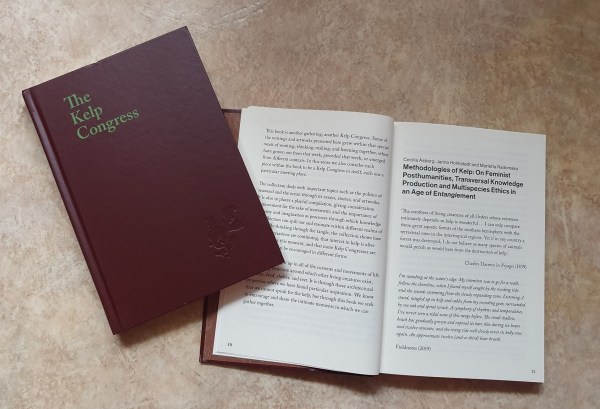
Last month the book The Kelp Congress (in English) / Tangboka (in Norwegian), edited by Hilde Mehti, Neal Cahoon and Annette Wolfsberger, was published by NNKS Press (Nordnorsk kunstnersenter). The volume contains contributions by the participants of the Kelp Congress, an event forming part of Lofoten International Art Festival, which took place in September 2019. Among many brilliant chapters by artists and researchers you may also find an essay by Cecilia Åsberg, Janna Holmstedt and myself, entitled ‘Methodologies of Kelp: On Feminist Posthumanities, Transversal Knowledge Production and Multispecies Ethics in an Age of Entanglement’.
For more info on how to order the book, see The Kelp Congress website.
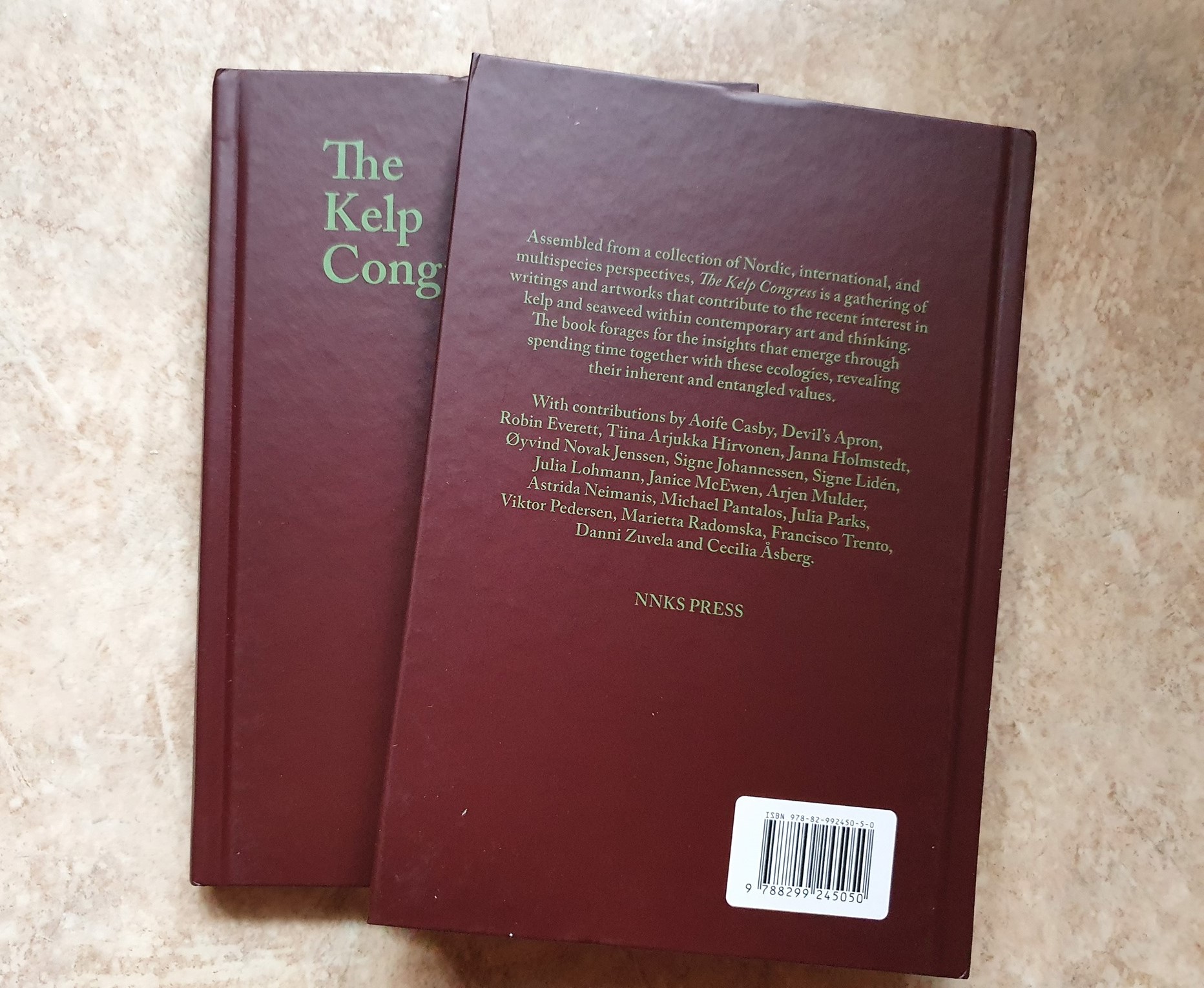

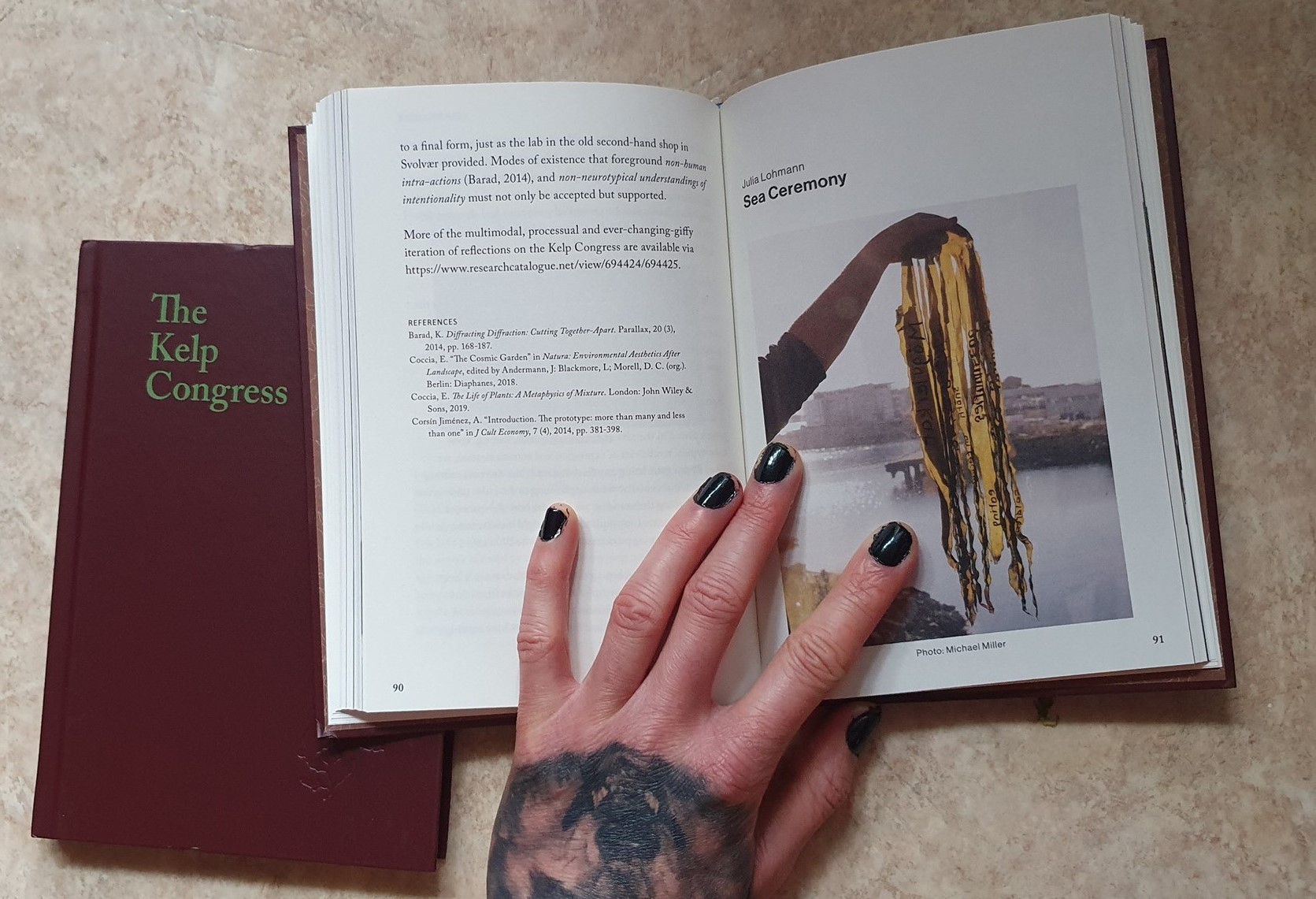
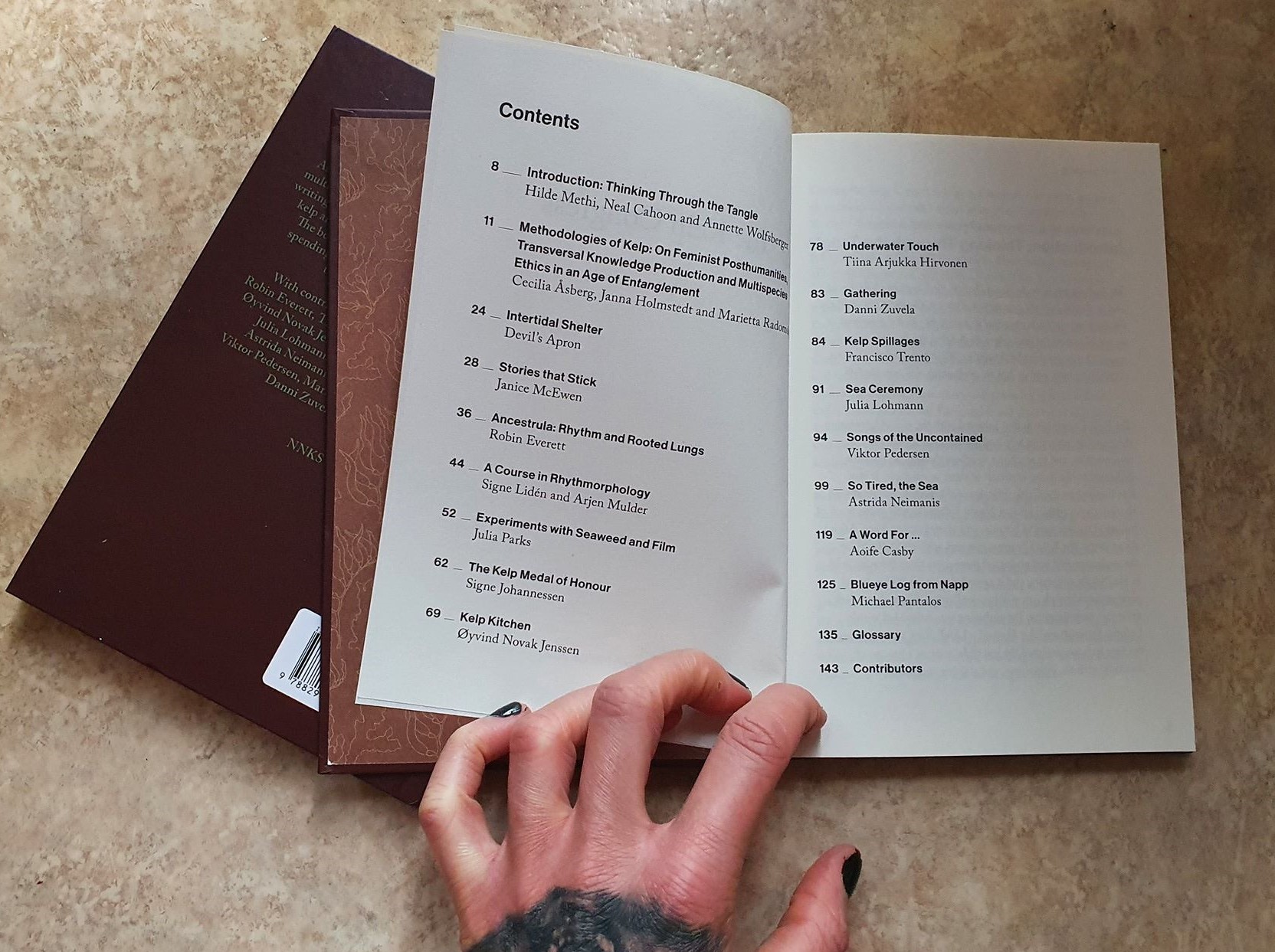
More on the book itself:
Assembled from a collection of Nordic, international, and multispecies perspectives, The Kelp Congress is a gathering of writings and artworks that contribute to the recent interest in kelp and seaweed within contemporary art and thinking. The book forages for the insights that emerge through spending time together with these ecologies, revealing their inherent and entangled values.
Contributors: Aoife Casby, Devil’s Apron, Robin Everett, Tiina Arjukka Hirvonen, Janna Holmstedt, Øyvind Novak Jenssen, Signe Johannessen, Signe Lidén, Julia Lohmann, Janice McEwen, Arjen Mulder, Astrida Neimanis, Michael Pantalos, Julia Parks, Viktor Pedersen, Marietta Radomska, Francisco Trento, Danni Zuvela and Cecilia Åsberg.
And a little bit more on our contribution:
C. Åsberg, J. Holmstedt and M. Radomska, 2020. Methodologies of Kelp: On Feminist Posthumanities, Transversal Knowledge Production and Multispecies Ethics in an Age of Entanglement. In: The Kelp Congress, edited by H. Mehti, N. Cahoon, and A. Wolfsberger, Svolvær: NNKS Press, pp. 11-23.
Abstract:
This chapter takes departure in the experience gathered through our participation in two workshops: Kelp Curing and Coast, Line, forming part of the Kelp Congress, as well as our daily research and art practices. We take kelp as material entities immersed in a multitude of relations with other creatures (for whom kelp serves as both nourishment and shelter) and inorganic elements of the milieu it resides in, on the one hand, and as a figuration: a material-semiotic “map of contestable worlds” that encompasses entangled threads of “knowledge, practice and power” (Haraway 1997, 11) in its local and global sense, on the other. While drawing on our field notes from the congress and feminist posthumanities and environmental humanities literatures (e.g. Alaimo 2016; Åsberg & Braidotti 2018; Sandilands & Erickson 2010; Iovino & Opperman 2014) – with a special focus on the so-called blue humanities/oceanic humanities (e.g. DeLoughrey 2019) – that unpack human/nonhuman relations in the context of the current environmental crisis and the accompanying “slow violence” (Nixon 2011), we mobilise a reflection on and make a proposal for “thinking with kelp” as a multi-faceted methodology of transversal and transdisciplinary knowledge production and practices: situated (Haraway 1988), enfleshed, transcorporeal (Alaimo 2010), collaborative, and committed to an ethics of multispecies response-ability (Haraway 2008).
You may read it HERE.

 Marietta Radomska
You must be logged in to post a comment.