Seminar on Queer Death Aesthetics, 27th May on Zoom

I am curating The Posthumanities Hub Seminar on Queer Death Aesthetics, which takes place on 27th May at 13:15 – 15:00 CEST and is organised in collaboration with my research group The Eco- and Bioart Lab.

The speakers are: Karolina Żyniewicz (University of Warsaw, PL) and Jacob B. Riis (Aarhus University, DK).

For more details, also on how to REGISTER for the event, see below.

Welcome to the Posthumanities Hub Seminar on Queer Death Aesthetics with speakers: Karolina Żyniewicz (University of Warsaw) and Jacob B. Riis (Aarhus University)!

Queer Death Studies (QDS) is an emerging transdisciplinary field that critically investigates and challenges conventional normativities, assumptions and expectations surrounding the issues of death, dying and mourning in the contemporary world. In particular, QDS pays attention to the ways planetary-scale necropolitics render some lives and deaths more recognised, understood or grievable than others.  If ‘queering’ in QDS is understood in a broad, open-ended sense as strange-making, defamiliarising, where the critical defamiliarisation implied may lead to an opening of other, more affirmative horizons, what would then ‘queer death aesthetics’ mean? During the seminar we will try to tackle this question in depth…

The event is curated by Dr Marietta Radomska and is organised in collaboration with The Eco- and Bioart Lab.

When: 27th May 2021, 13:15 – 15:00 CEST

Where: On Zoom

REGISTRATION: In order to take part in the seminar, please register by sending an email to the.posthumanities.hub@gmail.com by 25th May 2021 at noon (CEST) the latest.

The Zoom link will be sent to you on 26th May.

Speakers:

Safe suicide – becoming immortal and dying anyway.

By Karolina Żyniewicz

How to experience immortal life and death at the same time? How to do it safely, without a risk? Are cells isolated from my body still part of me? These were the main questions which I asked to myself and to my scientific collaborators in the beginning of working on safe suicide project. The project was transmattering on many different levels, a transformation of the body and its notion, understanding of life and death coalition, cognitive production, artistic expression. In the frame of the project I immortalised my cells, B lymphocytes just in order to decide about their death. Technically speaking, it was giving to them/myself immortality to take it back in many different experiments. It was being a donor, an observer, a caretaker and a killer at the same time. The project does not give precise answers for the posted questions but it allows to envision what means being liminal, being many and being constantly reconfigured.

Bio

Karolina Żyniewicz is an artist (2009 graduated from the Academy of Fine Arts in Łódź, Department of Visual Arts) and researcher, PhD student (Nature-Culture Transdisciplinary PhD Program at Artes Liberales Faculty, University of Warsaw). Working in a laboratory (mostly at the Institute of Genetics and Biotechnology, Faculty of Biology, University of Warsaw) locates her works in the field of bio art, although she tries to avoid using this term.

Are we dead yet?

By Jacob B. Riis

One of the defining characteristics in human behavioural modernity is burial of the dead in conjunction with ritual and art – art’s primordial love affair is with putrefying corpses. This project outlines a genre that utilises material corpses to produce contemporary art pieces. I currently conceptualise this art form as Necro Art, which serves to connect it to Mbembian inspired Necro Aesthetics and simultaneously establish it as its own field or genre within Art History. While perhaps being a version of Body Art originating in Viennese Actionism, Necro Art simultaneously aligns along different trajectories. It samples and shuffles in early human ritual, folkloric, pagan and rural art forms usually not present in realms of High/Academic Art, and brings the overlooked, the spectral, the magical, and the illiterate too Art History. Through focus on materiality, agency and constellations of subjectivities, each artwork conjures ghosts, reveals life where there is none, and allows its experiencer to connect with the dead, forcing us to reconsider the boundaries of life.

Bio

Jacob B. Riis, Art historian (graduated from Copenhagen University in 2014), 2009-2014 Curator Assistant at The Danish Museum of National History, Hillerød, 2014-2018 Head of Teaching and Curator at Ordrupgaard in Copenhagen, currently PhD student at Art History, Aarhus University.

Photos included in the poster:

(1) Portrait of Karolina Żyniewicz by Pawel Jozwiak (CSW Laznia, Gdansk; LEFT) and 

(2) Untitled (Portrait of Ross in L.A.), 1991, by Felix Gonzalez-Torres (RIGHT).

Watch online: “(Bio)art & ecologies of non/living matters: A conversation between visual artist Emanuela Cusin and philosopher Marietta Radomska.”

In case you missed the event ‘(Bio)art & ecologies of non/living matters’ that was livestreamed last month, fear not… The recording of the session is now available on University of Birmingham YouTube channel (see below).

About the event:

Visual artist Emanuela Cusin (Wysing Arts Centre, Cambridge (UK)) and philosopher Dr Marietta Radomska (Assistant Professor in Environmental Humanities, Linköping University (SE)) present their artistic and philosophical engagements with the matter(s)—and materialisation—of (bio)art and ecologies of the non/living. They do so against the backdrop of these more-than-human crisis times that are afflicted by political and pandemic violence, (counter)terrorist acts and events, and processes of mourning, trauma, and commemoration.

Symposium ‘det gode liv/The Sweetness of Living’ at Barents Spektakel Festival, 20th Feb 2021!

Check out the exciting online event: det gode liv/The Sweetness of Living forming part of the Barents Spektakel festival, taking place on 17-21 February in Kirkenes, Norway. The symposium itself is scheduled on 20th February (Saturday) from 10:00 to 14:00 CET. It takes place both on location and online. In order to register, fill out the form here.

Here’s a short description of the event, taken from the organisers’ website:

det gode liv // The Sweetness of Living is a networking, knowledge exchange, and experience-sharing artistic research and contemporary art project that begins in February 2021 and extends into the long-term future. 

The research takes its inspiration from the publication Global Warming and the Sweetness of Life: A Tar Sands Tale (2018) by Matt Hern and Am Johal, where the authors investigate philosopher Giorgio Agamben’s invocation of Alexandre Kojeve’s phrase ‘la dolce vita’.

These ideas describe a common attitude in Spain, Italy, and southern Europe that is claimed to be qualitatively different from the Protestant work ethic of northern European countries. Agamben’s claim is that this attitude describes a wholly different relationship to the future, a recovery of time, a resistance to capitalism, and the preservation of a significant way of living: in short, the capacity to define life as something outside of work.

det gode liv // The Sweetness of Living builds on these gestures, investigating and challenging what ‘the sweetness of life’ represents specifically in the Barents region / the nordic countries and north-west Russia / Sápmi. The project  is grounded in the belief that the topic has become an urgent cultural question following the events of 2020, when the present societal changes taking place during the Covid-19 pandemic have urged a radical re-configuration of the priorities of life and living.

The project begins by opening up the topic through three artworks and through several discursive, performative, and processual responses under The Sweetness of Living Symposium.

Among the speakers you can also find myself and Cecilia Åsberg with our talk on “More than survival: weaving vulnerabilities, questioning certainties, mobilising resilience. On low-trophic theories-practices for a more-than-human world”, starting at 12:00 sharp! Hope to see you there!

New Publication: “Non/Living Queerings, Undoing Certainties, Braiding Vulnerabilities: A Collective Reflection”

The latest issue of Artnodes: E-journal for Art, Science and Technology, focused on ‘Art in the Time of Pandemic’ and edited by Laura Benitez and Erich Berger is finally out and available in OPEN ACCESS. Inside you may also find a contribution by myself, Mayra Citllali Rojo Gómez, Margherita Pevere and Terike Haapoja, entitled: ‘Non/Living Queerings, Undoing Certainties, Braiding Vulnerabilities: A Collective Reflection’. You can read our article here.

Abstract:

The ongoing global pandemic of Covid-19 has exposed SARS-CoV-2 as a potent non-human actant that resists the joint scientific, public health and socio-political efforts to contain and understand both the virus and the illness. Yet, such a narrative appears to conceal more than it reveals. The seeming agentiality of the novel coronavirus is itself but one manifestation of the continuous destruction of biodiversity, climate change, socio-economic inequalities, neocolonialism, overconsumption and the anthropogenic degradation of nature. Furthermore, focusing on the virus – an entity that holds an ambiguous status between the ‘living’ and ‘non-living’ – brings into question the issue of the agentiality of non/living matter. While the story of viral potency seems to get centre stage, overshadowing the complex and perverse entanglement of processes and phenomena which  activated these potentials in the first place, the Covid-19 pandemic also becomes a prism that sheds light on the issues of environmental violence; social and environmental injustices; more-than-human agentiality; and ethico-political responses that the present situation may mobilise.

This article serves as a written record of joint conversations between artists and researchers in the working group ‘Non/Living Queerings’ that formed part of the online series of events ‘Braiding Friction’ organised by the research project Biofriction. The article strives to capture the collective effort of braiding and weaving a variety of situated perspectives, theoretical toolboxes, knowledges and experiences against the background of the ongoing Covid-19 pandemic. In particular, the text focuses on the issues of crisis, ‘amplification effect’, viral agency and the changing notions of humanity.

Keywords

the non/living, queering, Covid-19 pandemic, art, vulnerability, amplification

Reference:

Radomska, Marietta, Rojo Gómez, Mayra Citlalli, Pevere, Margherita, Haapoja, Terike. “Non/Living Queerings, Undoing Certainties, and Braiding Vulnerabilities: A Collective Reflection”. Artnodes, [online], 2021, No. 27, doi:10.7238/a.v0i27.374989 .

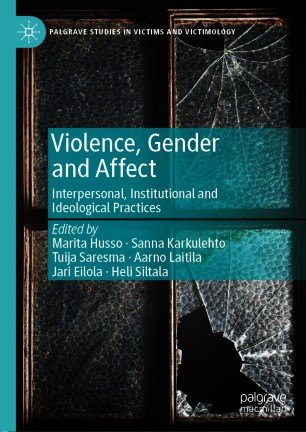
New publication: Environmental Violence and Postnatural Oceans: Low-Trophic Theory in the Registers of Feminist Posthumanities

It is my great pleasure to say that the chapter “Environmental Violence and Postnatural Oceans: Low-Trophic Theory in the Registers of Feminist Posthumanities” , written by Cecilia Åsberg and myself, has just been published as part of the exciting volume “Violence, Gender and Affect”, edited by Marita Husso, Sanna Karkulehto, Tuija Saresma, Aarno Laitila, Jari Eilola and Heli Siltala.

The book came out in the series Palgrave Studies in Victims and Victimology.

More on our contribution:

“Environmental Violence and Postnatural Oceans: Low-Trophic Theory in the Registers of Feminist Posthumanities” by Cecilia Åsberg and Marietta Radomska

Abstract:

Environmental violence takes form of both ‘spectacular’ events, like ecological disasters usually recognised by the general public, and ‘slow violence’, a type of violence that occurs gradually, out of sight and on a long-term scale. Planetary seas and oceans, loaded with cultural meanings of that which ‘hides’ and ‘allows to forget’, are the spaces where such attritional violence unfolds unseen and ‘out of mind’. Simultaneously, conventional concepts of nature and culture, as dichotomous entities, become obsolete. We all inhabit and embody the world differently, as variously situated people, divided by national, sexual, bodily and economic status, and as very variously situated nonhumans in an increasingly anthropogenic world. This chapter focuses on subtle ‘slow violence’ unfolding through the instances of submerged chemical weapons, so-called dead zones, invasive species and high- and low-trophic mariculture in the Baltic and North Sea regions. It zooms in on the select cases of such ‘environed bodies’, their stories of excruciating slow violence and yet also on unexpected encounters with care and hospitality. The aim is to unfold a lowtrophic theory for the naturecultural research on violence and care within environmental humanities, and to engage a coexistential ethics of environmental adaptability informed by feminist posthumanities.

Keywords:

Environmental violence; Seas and oceans; Low-trophic theory; Feminist posthumanities 

Åsberg C., Radomska M. (2021) Environmental Violence and Postnatural Oceans: Low-Trophic Theory in the Registers of Feminist Posthumanities. In: Husso M., Karkulehto S., Saresma T., Laitila A., Eilola J., Siltala H. (eds) Violence, Gender and Affect. Palgrave Studies in Victims and Victimology. Palgrave Macmillan, Cham. https://doi.org/10.1007/978-3-030-56930-3_13

You may also check out this short clip posted on The Seed Box A Mistra Formas Environmental Humanities Collaboratory website/YouTube channel:

Call for short contributions (500-2000 words): What do we talk about when we talk about queer death? (Whatever Journal)

Check out this exciting CfP! DEADLINE: 15 January 2021!

Machinic Assemblage's avatarQueer Death Studies Network

Whatever. A Transdisciplinary Journal of Queer Theories and Studies (https://whatever.cirque.unipi.it/) is inviting submissions for short contributions (500-2000 words) to be collected in a multi-authored article entitled “What do we talk about when we talk about queer death?”. The article will introduce the themed section Queer thanatologies (edited by A.C. Corradino, C. Dell’Aversano, R. Langhi and M. Petricola) that will appear in Whatever’s next issue in summer 2021.

Queer death studies has recently emerged as a transdisciplinary field of inquiry investigating the cultural performances related to death, dying, grief, and disposal from the perspective of queer theory, defined as a hermeneutical stance whose premises could be summed up as follows: «queer states that any construction of identity (including LGBT ones) is a performance constituting a subject which does not “exist” prior to it, and encourages to bring into being (both as objects of desire, of fantasy…

View original post 359 more words

New Publication: contribution to ‘Rehearsing Hospitalities Companion 2’

Frame Contemporary Art Finland’s public programme Rehearsing Hospitalities (2019-2023) connects artists, curators and other practitioners in the field of contemporary art and beyond in order to build up and mediate new practices, understandings and engagements with diverse hospitalities. In September 2020 RH held a series of events under the same title and published a new volume Rehearsing Hospitalities Companion 2. The book is edited by Yvonne Billimore and Jussi Koitela, and is available in OPEN ACCESS via Archive Books.

Inside you may find a chapter written by me ‘Viral Queering, Amplified Vulnerabilities’ (pp. 155-172).

You can check it out here.

And watch the online series of events on the Frame YouTube Channel.

And here comes a little snippet about the project taken from RH website:

Rehearsing Hospitalities Companion 2 is the second in a series of readers published by Frame Contemporary Art Finland and Archive Books, which accompany Frame’s five-year public programme Rehearsing Hospitalities.

The Rehearsing Hospitalities Companion series makes visible the processes and influences that shape the content and relations within the wider Rehearsing Hospitalities programme. The first edition in the series centered how to become more hospitable to diverse ways of knowing. The second edition leads on from this by introducing questions of access and considering access from multiple approaches, perceptions and relations.

“Now more than ever we need to be consciously reconsidering diverse forms of hospitalities and ways of being together”, say the editors Yvonne Billimore and Jussi Koitela. “With this publication we wanted to look beyond normative and institutionalised understandings of access. How can arts organisations and institutions treat access not as general or universal policy, but instead understand access needs as coming from plural and decentralised ways of knowing and experiencing the world?”

The 2020 publication came together during times marked by a myriad of global crises (COVID-19, racialized violence, ecological emergency, being among the most prominent). It is in these disconnected times that the publication and its contributors have turned to hospitality. Rehearsing Hospitalities Companion 2 is a site hosting and gathering, for coming together to re-visit, re-turn and re-configure worlds of hospitaties.

With contributions coming from a range of practitioners all with differing backgrounds, writing styles and approaches, the publication welcomes engagement across disciplines. It aims to spark critical thinking, discussion and action on access and hospitality in the field of arts and culture, and beyond.

New Publication: Special issue of the journal Australian Feminist Studies focused on Queer Death Studies

I am delighted to say that the special issue of the journal Australian Feminist Studies focused on the topic of “Queer Death Studies” and co-edited by myself, Tara Mehrabi and Nina Lykke, has finally been published.

The issue contains contributions by QDS scholars: Patricia MacCormack, Marietta Radomska, Tara Mehrabi, Stine Willum Adrian, Margrit Shildrick, Hema’ny Molina Vargas, Camila Marambio and Nina Lykke.

The collection strives to advance queerfeminist methodologies and ontological, ethical and political understandings that critically and creatively attend to the problem of death, dying and mourning in the current environmental, cultural, and socio-political contexts.

In order to learn more, do check out the introduction “Queer Death Studies: Death, Dying and Mourning From a Queerfeminist Perspective”, co-authored by myself, Tara and Nina, available in OA here.

Website Built with WordPress.com.

Up ↑