New publication: “Mourning the More-Than-Human: Somatechnics of Environmental Violence, Ethical Imaginaries, and Arts of Eco-Grief”

Exciting news! The long awaited part 2 of the special issue of the journal Somatechnics, focused on the ‘Somatechnics of Violence: (Im)material, Affective, and Digital Transformations’ is finally out!

I feel privileged to have had a chance to contribute with an article (available in Open Access) to this wonderful, brilliant, and particularly timely volume!

Big congratulations of course go to the special issue editors: Evelien Geerts, Chantelle Gray and Delphi Carstens, and to all the wonderful contributors!

HERE you can check the entire issue.

And of course you are warmly invited to check out my contribution “Mourning the More-Than-Human: Somatechnics of Environmental Violence, Ethical Imaginaries, and Arts of Eco-Grief”, available in OA.

The article also discusses and features visual artworks by artists and creators: Polina Choni (UA), and Eglė Plytnikaitė, Agnė Stirnė and Oskaras Stirna (LT).

More about the article:

Theoretically grounded in queer death studies and environmental humanities, this article has a twofold aim. Firstly, it explores the somatechnics of environmental violence in the context of Northern and Eastern Europe, while paying attention to ongoing ecocide inflicted by Russia on Ukraine, and to the post-WW2 chemical weapon dumps in the Baltic Sea. Secondly, the article examines the concept of eco-grief in its close relation to artistic narratives on ecocide. By bridging the discussion on environmental violence and artistic renderings of eco-grief, the article hopes to contribute to a better understanding of the socio-cultural responses to more-than-human death and loss, and their accompanying ethical imaginaries and affordances.

Keywords: contemporary art; ecocide; eco-grief; environmental humanities; environmental violence; queer death studies.
New Publication: Dossier ‘What do we talk about when we talk about queer death?’ – Theories and Definitions

Recently I had a pleasure to contribute to the dossier ‘What do we talk about when we talk about queer death?’, edited by Mattia Petricola and published in the latest issue of the journal ‘Whatever: A transdisciplinary journal of queer theories and studies’.

You may find my short text ‘On queering death studies’ in the longer article ‘Theories and Definitions’, along with the fantastic contributions by Patricia MacCormack, Nina Lykke, Ida Hillerup Hansen, Phillip R. Olson and Nicholas Manganas.

Here comes the abstract:

This is part 1 of 6 of the dossier What Do We Talk about when We Talk about Queer Death?, edited by M. Petricola. The contributions collected in this article sit at the crossroads between thanatology and queer theory and tackle questions such as: how can we define queer death studies as a research field? How can queer death studies problematize and rethink the life-death binary? Which notions and hermeneutic tools could be borrowed from other disciplines in order to better define queer death studies?
The present article includes the following contributions: – MacCormack P., What does queer death studies mean?; – Radomska M., On queering death studies; – Lykke N., Death as vibrancy; – Hillerup Hansen I., What concreteness will do to resolve the uncertain; – Olson P., Queer objectivity as a response to denials of death; – Manganas N., The queer lack of a chthonic instinct.

MacCormack, P., M. Radomska, N. Lykke, I. Hillerup-Hansen, P. R. Olson, N. Manganas. 2021. What do we talk about when we talk about queer death? Theories and definitionsWhatever: Transdisciplinary Journal of Queer Theory and Studies, vol. 4: 573-598. https://doi.org/10.13131/2611-657X.whatever.v4i1.147

New Publication: Methodologies of Kelp

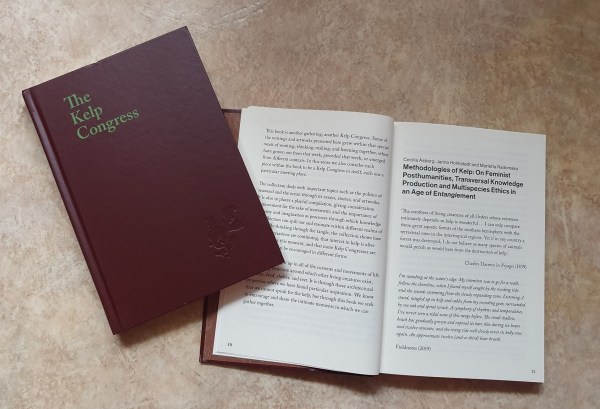
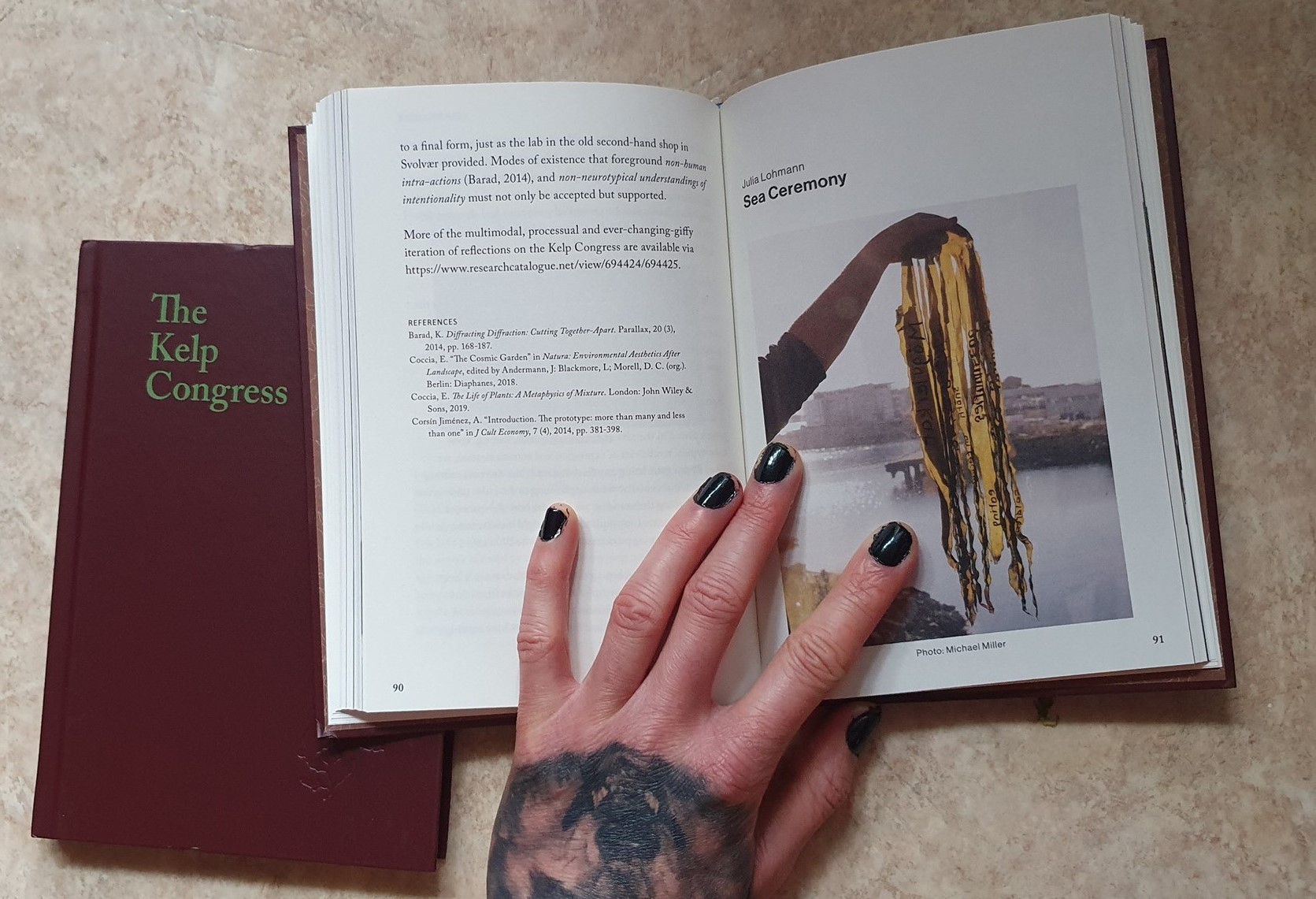
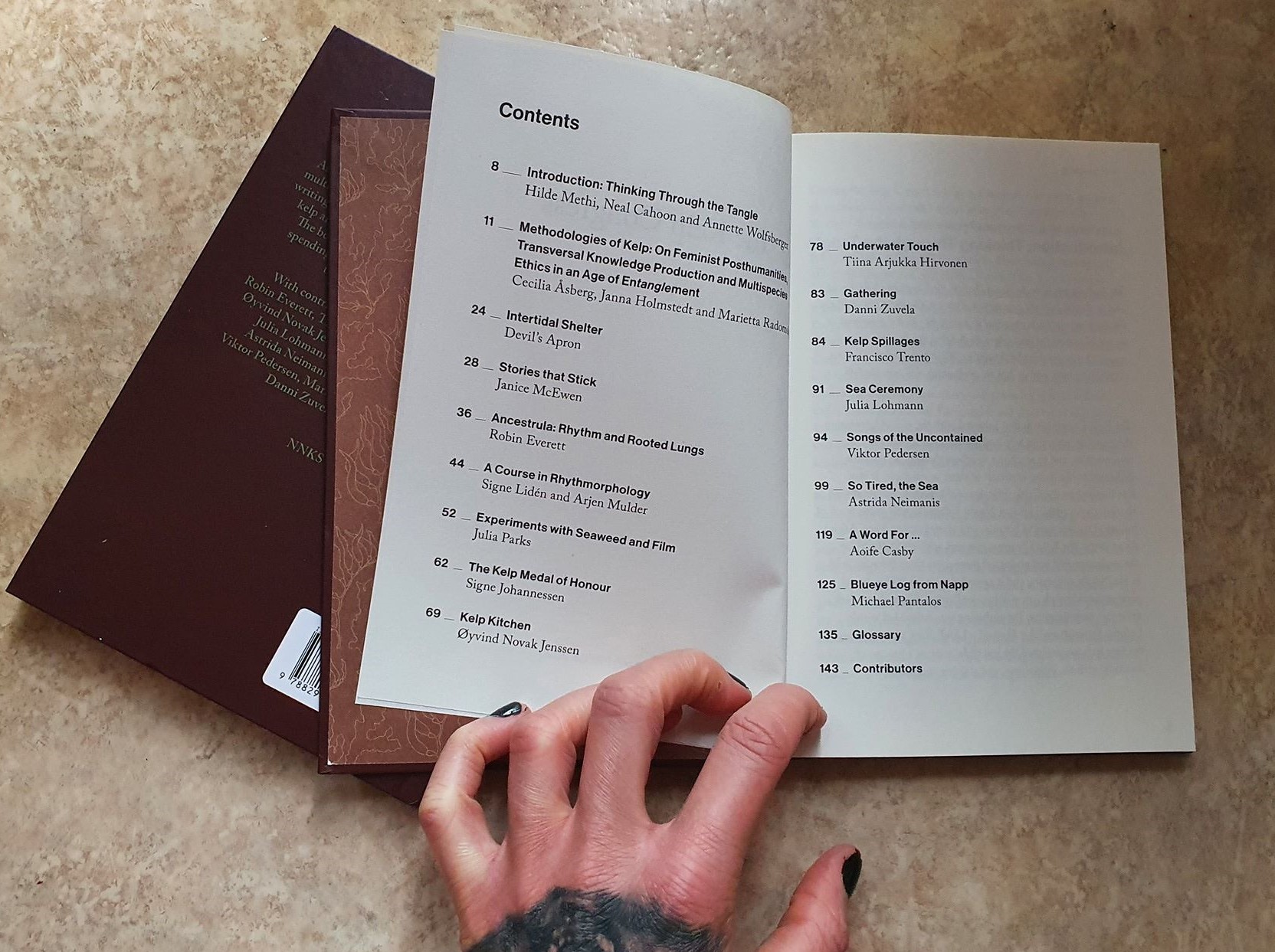
Last month the book The Kelp Congress (in English) / Tangboka (in Norwegian), edited by Hilde Mehti, Neal Cahoon and Annette Wolfsberger, was published by NNKS Press (Nordnorsk kunstnersenter). The volume contains contributions by the participants of the Kelp Congress, an event forming part of Lofoten International Art Festival, which took place in September 2019. Among many brilliant chapters by artists and researchers you may also find an essay by Cecilia Åsberg, Janna Holmstedt and myself, entitled ‘Methodologies of Kelp: On Feminist Posthumanities, Transversal Knowledge Production and Multispecies Ethics in an Age of Entanglement’.

For more info on how to order the book, see The Kelp Congress website.

More on the book itself:

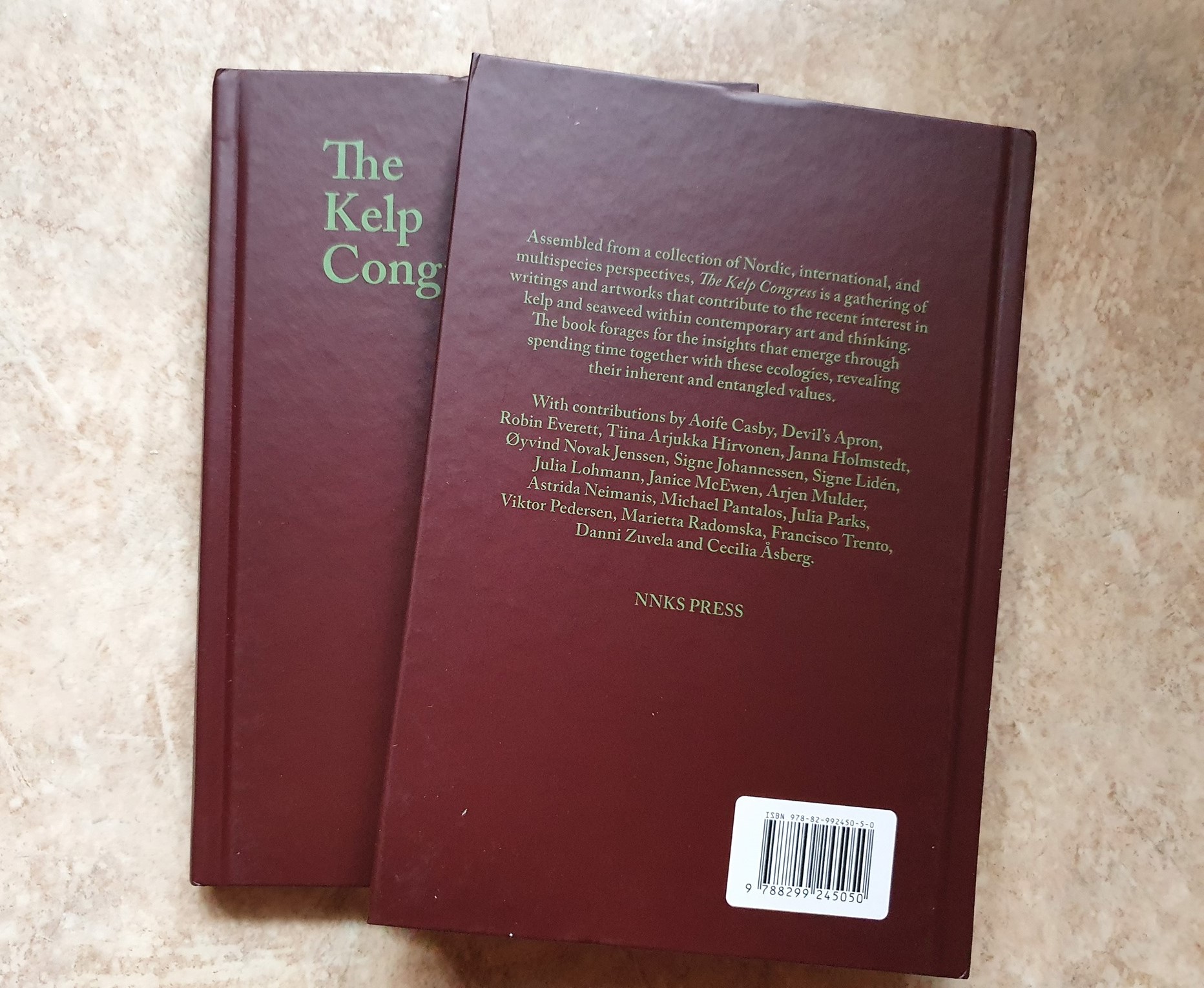
Assembled from a collection of Nordic, international, and multispecies perspectives, The Kelp Congress is a gathering of writings and artworks that contribute to the recent interest in kelp and seaweed within contemporary art and thinking. The book forages for the insights that emerge through spending time together with these ecologies, revealing their inherent and entangled values.

Contributors: Aoife Casby, Devil’s Apron, Robin Everett, Tiina Arjukka Hirvonen, Janna Holmstedt, Øyvind Novak Jenssen, Signe Johannessen, Signe Lidén, Julia Lohmann, Janice McEwen, Arjen Mulder, Astrida Neimanis, Michael Pantalos, Julia Parks, Viktor Pedersen, Marietta Radomska, Francisco Trento, Danni Zuvela and Cecilia Åsberg.

And a little bit more on our contribution:

C. Åsberg, J. Holmstedt and M. Radomska, 2020. Methodologies of Kelp: On Feminist Posthumanities, Transversal Knowledge Production and Multispecies Ethics in an Age of Entanglement. In: The Kelp Congress, edited by H. Mehti, N. Cahoon, and A. Wolfsberger, Svolvær: NNKS Press, pp. 11-23.

Abstract:

This chapter takes departure in the experience gathered through our participation in two workshops: Kelp Curing and Coast, Line, forming part of the Kelp Congress, as well as our daily research and art practices. We take kelp as material entities immersed in a multitude of relations with other creatures (for whom kelp serves as both nourishment and shelter) and inorganic elements of the milieu it resides in, on the one hand, and as a figuration: a material-semiotic “map of contestable worlds” that encompasses entangled threads of “knowledge, practice and power” (Haraway 1997, 11) in its local and global sense, on the other. While drawing on our field notes from the congress and feminist posthumanities and environmental humanities literatures (e.g. Alaimo 2016; Åsberg & Braidotti 2018; Sandilands & Erickson 2010; Iovino & Opperman 2014) – with a special focus on the so-called blue humanities/oceanic humanities (e.g. DeLoughrey 2019) – that unpack human/nonhuman relations in the context of the current environmental crisis and the accompanying “slow violence” (Nixon 2011), we mobilise a reflection on and make a proposal for “thinking with kelp” as a multi-faceted methodology of transversal and transdisciplinary knowledge production and practices: situated (Haraway 1988), enfleshed, transcorporeal (Alaimo 2010), collaborative, and committed to an ethics of multispecies response-ability (Haraway 2008).

You may read it HERE.

Website Built with WordPress.com.

Up ↑