New publication: “Mourning the More-Than-Human: Somatechnics of Environmental Violence, Ethical Imaginaries, and Arts of Eco-Grief”

Exciting news! The long awaited part 2 of the special issue of the journal Somatechnics, focused on the ‘Somatechnics of Violence: (Im)material, Affective, and Digital Transformations’ is finally out!

I feel privileged to have had a chance to contribute with an article (available in Open Access) to this wonderful, brilliant, and particularly timely volume!

Big congratulations of course go to the special issue editors: Evelien Geerts, Chantelle Gray and Delphi Carstens, and to all the wonderful contributors!

HERE you can check the entire issue.

And of course you are warmly invited to check out my contribution “Mourning the More-Than-Human: Somatechnics of Environmental Violence, Ethical Imaginaries, and Arts of Eco-Grief”, available in OA.

The article also discusses and features visual artworks by artists and creators: Polina Choni (UA), and Eglė Plytnikaitė, Agnė Stirnė and Oskaras Stirna (LT).

More about the article:

Theoretically grounded in queer death studies and environmental humanities, this article has a twofold aim. Firstly, it explores the somatechnics of environmental violence in the context of Northern and Eastern Europe, while paying attention to ongoing ecocide inflicted by Russia on Ukraine, and to the post-WW2 chemical weapon dumps in the Baltic Sea. Secondly, the article examines the concept of eco-grief in its close relation to artistic narratives on ecocide. By bridging the discussion on environmental violence and artistic renderings of eco-grief, the article hopes to contribute to a better understanding of the socio-cultural responses to more-than-human death and loss, and their accompanying ethical imaginaries and affordances.

Keywords: contemporary art; ecocide; eco-grief; environmental humanities; environmental violence; queer death studies.

New Publication: Dossier ‘What do we talk about when we talk about queer death?’ – Theories and Definitions

Recently I had a pleasure to contribute to the dossier ‘What do we talk about when we talk about queer death?’, edited by Mattia Petricola and published in the latest issue of the journal ‘Whatever: A transdisciplinary journal of queer theories and studies’.

You may find my short text ‘On queering death studies’ in the longer article ‘Theories and Definitions’, along with the fantastic contributions by Patricia MacCormack, Nina Lykke, Ida Hillerup Hansen, Phillip R. Olson and Nicholas Manganas.

Here comes the abstract:

This is part 1 of 6 of the dossier What Do We Talk about when We Talk about Queer Death?, edited by M. Petricola. The contributions collected in this article sit at the crossroads between thanatology and queer theory and tackle questions such as: how can we define queer death studies as a research field? How can queer death studies problematize and rethink the life-death binary? Which notions and hermeneutic tools could be borrowed from other disciplines in order to better define queer death studies?
The present article includes the following contributions: – MacCormack P., What does queer death studies mean?; – Radomska M., On queering death studies; – Lykke N., Death as vibrancy; – Hillerup Hansen I., What concreteness will do to resolve the uncertain; – Olson P., Queer objectivity as a response to denials of death; – Manganas N., The queer lack of a chthonic instinct.

MacCormack, P., M. Radomska, N. Lykke, I. Hillerup-Hansen, P. R. Olson, N. Manganas. 2021. What do we talk about when we talk about queer death? Theories and definitionsWhatever: Transdisciplinary Journal of Queer Theory and Studies, vol. 4: 573-598. https://doi.org/10.13131/2611-657X.whatever.v4i1.147

New Publication: Fathoming Postnatural Oceans…

It is my great pleasure to say that our latest article, dealing with postnatural ecologies, non/liveability and low-trophic ecosystems and maricultures of the Baltic and North Sea is finally out in Environment and Planning E: Nature and Space (OPEN ACCESS)!

Radomska, M. and C. Åsberg. 2021Fathoming Postnatural Oceans: Towards a Low-Trophic Theory in the Practices of Feminist PosthumanitiesEnvironment and Planning E: Nature and Spacehttps://doi.org/10.1177/25148486211028542

Check it out!

Abstract:

As the planet’s largest ecosystem, oceans stabilise climate, produce oxygen, store CO2 and host unfathomable biodiversity at a deep time-scale. In recent decades, scientific assessments have indicated that the oceans are seriously degraded to the detriment of most near-future societies. Human-induced impacts range from climate change, ocean acidification, loss of biodiversity, eutrophication and marine pollution to local degradation of marine and coastal environments. Such environmental violence takes form of both ‘spectacular’ events, like oil spills and ‘slow violence’, occurring gradually and out of sight. The purpose of this paper is to show four cases of coastal and marine forms of slow violence and to provide counter-accounts of how to reinvent our consumer imaginary at such locations, as well as to develop what is here referred to as ‘low-trophic theory,’ a situated ethical stance that attends to entanglements of consumption, food, violence, environmental adaptability and more-than-human care from the co-existential perspective of multispecies ethics. We combine field-philosophical case studies with insights from marine science, environmental art and cultural practices in the Baltic and North Sea region and feminist posthumanities. The paper shows that the oceanic imaginary is not a unified place, but rather, a set of forces, which requires renewed ethical approaches, conceptual inventiveness and practical creativity. Based on the case studies and examples presented, the authors conclude that the consideration of more-than-human ethical perspectives, provided by environmental arts and humanities is crucial for both research on nature and space, and for the flourishing of local multispecies communities. This paper thus inaugurates thinking and practice along the proposed here ethical stance of low-trophic theory, developed it along the methodological lines of feminist environmental posthumanities.

New Publication: “Non/Living Queerings, Undoing Certainties, Braiding Vulnerabilities: A Collective Reflection”

The latest issue of Artnodes: E-journal for Art, Science and Technology, focused on ‘Art in the Time of Pandemic’ and edited by Laura Benitez and Erich Berger is finally out and available in OPEN ACCESS. Inside you may also find a contribution by myself, Mayra Citllali Rojo Gómez, Margherita Pevere and Terike Haapoja, entitled: ‘Non/Living Queerings, Undoing Certainties, Braiding Vulnerabilities: A Collective Reflection’. You can read our article here.

Abstract:

The ongoing global pandemic of Covid-19 has exposed SARS-CoV-2 as a potent non-human actant that resists the joint scientific, public health and socio-political efforts to contain and understand both the virus and the illness. Yet, such a narrative appears to conceal more than it reveals. The seeming agentiality of the novel coronavirus is itself but one manifestation of the continuous destruction of biodiversity, climate change, socio-economic inequalities, neocolonialism, overconsumption and the anthropogenic degradation of nature. Furthermore, focusing on the virus – an entity that holds an ambiguous status between the ‘living’ and ‘non-living’ – brings into question the issue of the agentiality of non/living matter. While the story of viral potency seems to get centre stage, overshadowing the complex and perverse entanglement of processes and phenomena which  activated these potentials in the first place, the Covid-19 pandemic also becomes a prism that sheds light on the issues of environmental violence; social and environmental injustices; more-than-human agentiality; and ethico-political responses that the present situation may mobilise.

This article serves as a written record of joint conversations between artists and researchers in the working group ‘Non/Living Queerings’ that formed part of the online series of events ‘Braiding Friction’ organised by the research project Biofriction. The article strives to capture the collective effort of braiding and weaving a variety of situated perspectives, theoretical toolboxes, knowledges and experiences against the background of the ongoing Covid-19 pandemic. In particular, the text focuses on the issues of crisis, ‘amplification effect’, viral agency and the changing notions of humanity.

Keywords

the non/living, queering, Covid-19 pandemic, art, vulnerability, amplification

Reference:

Radomska, Marietta, Rojo Gómez, Mayra Citlalli, Pevere, Margherita, Haapoja, Terike. “Non/Living Queerings, Undoing Certainties, and Braiding Vulnerabilities: A Collective Reflection”. Artnodes, [online], 2021, No. 27, doi:10.7238/a.v0i27.374989 .

New publication: Environmental Violence and Postnatural Oceans: Low-Trophic Theory in the Registers of Feminist Posthumanities

It is my great pleasure to say that the chapter “Environmental Violence and Postnatural Oceans: Low-Trophic Theory in the Registers of Feminist Posthumanities” , written by Cecilia Åsberg and myself, has just been published as part of the exciting volume “Violence, Gender and Affect”, edited by Marita Husso, Sanna Karkulehto, Tuija Saresma, Aarno Laitila, Jari Eilola and Heli Siltala.

The book came out in the series Palgrave Studies in Victims and Victimology.

More on our contribution:

“Environmental Violence and Postnatural Oceans: Low-Trophic Theory in the Registers of Feminist Posthumanities” by Cecilia Åsberg and Marietta Radomska

Abstract:

Environmental violence takes form of both ‘spectacular’ events, like ecological disasters usually recognised by the general public, and ‘slow violence’, a type of violence that occurs gradually, out of sight and on a long-term scale. Planetary seas and oceans, loaded with cultural meanings of that which ‘hides’ and ‘allows to forget’, are the spaces where such attritional violence unfolds unseen and ‘out of mind’. Simultaneously, conventional concepts of nature and culture, as dichotomous entities, become obsolete. We all inhabit and embody the world differently, as variously situated people, divided by national, sexual, bodily and economic status, and as very variously situated nonhumans in an increasingly anthropogenic world. This chapter focuses on subtle ‘slow violence’ unfolding through the instances of submerged chemical weapons, so-called dead zones, invasive species and high- and low-trophic mariculture in the Baltic and North Sea regions. It zooms in on the select cases of such ‘environed bodies’, their stories of excruciating slow violence and yet also on unexpected encounters with care and hospitality. The aim is to unfold a lowtrophic theory for the naturecultural research on violence and care within environmental humanities, and to engage a coexistential ethics of environmental adaptability informed by feminist posthumanities.

Keywords:

Environmental violence; Seas and oceans; Low-trophic theory; Feminist posthumanities 

Åsberg C., Radomska M. (2021) Environmental Violence and Postnatural Oceans: Low-Trophic Theory in the Registers of Feminist Posthumanities. In: Husso M., Karkulehto S., Saresma T., Laitila A., Eilola J., Siltala H. (eds) Violence, Gender and Affect. Palgrave Studies in Victims and Victimology. Palgrave Macmillan, Cham. https://doi.org/10.1007/978-3-030-56930-3_13

You may also check out this short clip posted on The Seed Box A Mistra Formas Environmental Humanities Collaboratory website/YouTube channel:

New Publication: contribution to ‘Rehearsing Hospitalities Companion 2’

Frame Contemporary Art Finland’s public programme Rehearsing Hospitalities (2019-2023) connects artists, curators and other practitioners in the field of contemporary art and beyond in order to build up and mediate new practices, understandings and engagements with diverse hospitalities. In September 2020 RH held a series of events under the same title and published a new volume Rehearsing Hospitalities Companion 2. The book is edited by Yvonne Billimore and Jussi Koitela, and is available in OPEN ACCESS via Archive Books.

Inside you may find a chapter written by me ‘Viral Queering, Amplified Vulnerabilities’ (pp. 155-172).

You can check it out here.

And watch the online series of events on the Frame YouTube Channel.

And here comes a little snippet about the project taken from RH website:

Rehearsing Hospitalities Companion 2 is the second in a series of readers published by Frame Contemporary Art Finland and Archive Books, which accompany Frame’s five-year public programme Rehearsing Hospitalities.

The Rehearsing Hospitalities Companion series makes visible the processes and influences that shape the content and relations within the wider Rehearsing Hospitalities programme. The first edition in the series centered how to become more hospitable to diverse ways of knowing. The second edition leads on from this by introducing questions of access and considering access from multiple approaches, perceptions and relations.

“Now more than ever we need to be consciously reconsidering diverse forms of hospitalities and ways of being together”, say the editors Yvonne Billimore and Jussi Koitela. “With this publication we wanted to look beyond normative and institutionalised understandings of access. How can arts organisations and institutions treat access not as general or universal policy, but instead understand access needs as coming from plural and decentralised ways of knowing and experiencing the world?”

The 2020 publication came together during times marked by a myriad of global crises (COVID-19, racialized violence, ecological emergency, being among the most prominent). It is in these disconnected times that the publication and its contributors have turned to hospitality. Rehearsing Hospitalities Companion 2 is a site hosting and gathering, for coming together to re-visit, re-turn and re-configure worlds of hospitaties.

With contributions coming from a range of practitioners all with differing backgrounds, writing styles and approaches, the publication welcomes engagement across disciplines. It aims to spark critical thinking, discussion and action on access and hospitality in the field of arts and culture, and beyond.

New Publication: Special issue of the journal Australian Feminist Studies focused on Queer Death Studies

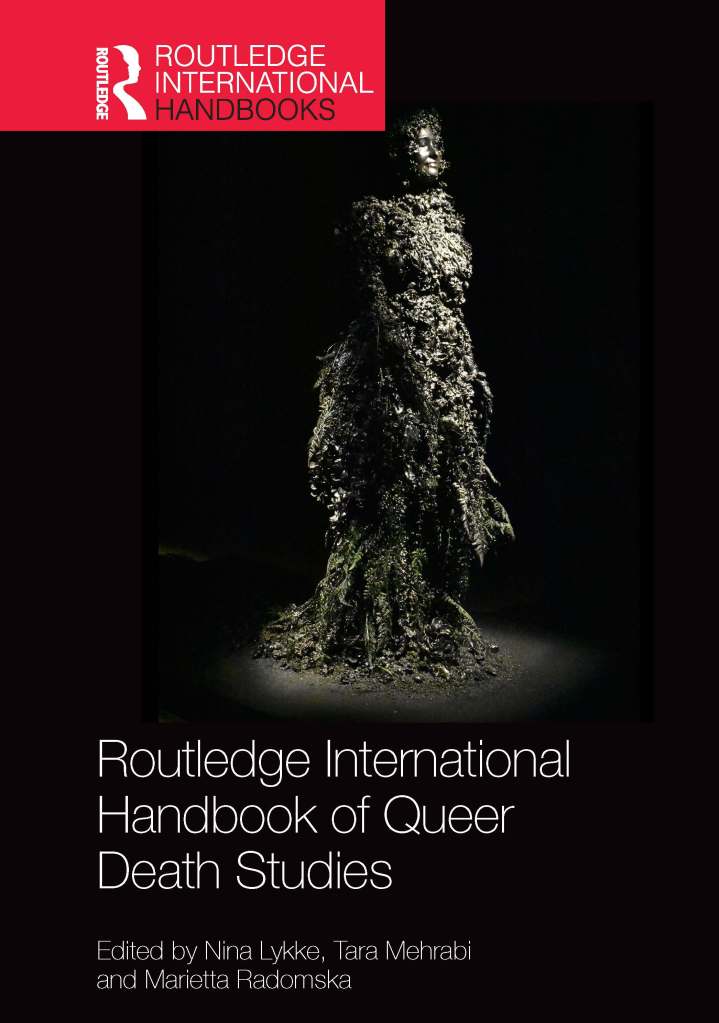
I am delighted to say that the special issue of the journal Australian Feminist Studies focused on the topic of “Queer Death Studies” and co-edited by myself, Tara Mehrabi and Nina Lykke, has finally been published.

The issue contains contributions by QDS scholars: Patricia MacCormack, Marietta Radomska, Tara Mehrabi, Stine Willum Adrian, Margrit Shildrick, Hema’ny Molina Vargas, Camila Marambio and Nina Lykke.

The collection strives to advance queerfeminist methodologies and ontological, ethical and political understandings that critically and creatively attend to the problem of death, dying and mourning in the current environmental, cultural, and socio-political contexts.

In order to learn more, do check out the introduction “Queer Death Studies: Death, Dying and Mourning From a Queerfeminist Perspective”, co-authored by myself, Tara and Nina, available in OA here.

New Publication: Methodologies of Kelp

Last month the book The Kelp Congress (in English) / Tangboka (in Norwegian), edited by Hilde Mehti, Neal Cahoon and Annette Wolfsberger, was published by NNKS Press (Nordnorsk kunstnersenter). The volume contains contributions by the participants of the Kelp Congress, an event forming part of Lofoten International Art Festival, which took place in September 2019. Among many brilliant chapters by artists and researchers you may also find an essay by Cecilia Åsberg, Janna Holmstedt and myself, entitled ‘Methodologies of Kelp: On Feminist Posthumanities, Transversal Knowledge Production and Multispecies Ethics in an Age of Entanglement’.

For more info on how to order the book, see The Kelp Congress website.

More on the book itself:

Assembled from a collection of Nordic, international, and multispecies perspectives, The Kelp Congress is a gathering of writings and artworks that contribute to the recent interest in kelp and seaweed within contemporary art and thinking. The book forages for the insights that emerge through spending time together with these ecologies, revealing their inherent and entangled values.

Contributors: Aoife Casby, Devil’s Apron, Robin Everett, Tiina Arjukka Hirvonen, Janna Holmstedt, Øyvind Novak Jenssen, Signe Johannessen, Signe Lidén, Julia Lohmann, Janice McEwen, Arjen Mulder, Astrida Neimanis, Michael Pantalos, Julia Parks, Viktor Pedersen, Marietta Radomska, Francisco Trento, Danni Zuvela and Cecilia Åsberg.

And a little bit more on our contribution:

C. Åsberg, J. Holmstedt and M. Radomska, 2020. Methodologies of Kelp: On Feminist Posthumanities, Transversal Knowledge Production and Multispecies Ethics in an Age of Entanglement. In: The Kelp Congress, edited by H. Mehti, N. Cahoon, and A. Wolfsberger, Svolvær: NNKS Press, pp. 11-23.

Abstract:

This chapter takes departure in the experience gathered through our participation in two workshops: Kelp Curing and Coast, Line, forming part of the Kelp Congress, as well as our daily research and art practices. We take kelp as material entities immersed in a multitude of relations with other creatures (for whom kelp serves as both nourishment and shelter) and inorganic elements of the milieu it resides in, on the one hand, and as a figuration: a material-semiotic “map of contestable worlds” that encompasses entangled threads of “knowledge, practice and power” (Haraway 1997, 11) in its local and global sense, on the other. While drawing on our field notes from the congress and feminist posthumanities and environmental humanities literatures (e.g. Alaimo 2016; Åsberg & Braidotti 2018; Sandilands & Erickson 2010; Iovino & Opperman 2014) – with a special focus on the so-called blue humanities/oceanic humanities (e.g. DeLoughrey 2019) – that unpack human/nonhuman relations in the context of the current environmental crisis and the accompanying “slow violence” (Nixon 2011), we mobilise a reflection on and make a proposal for “thinking with kelp” as a multi-faceted methodology of transversal and transdisciplinary knowledge production and practices: situated (Haraway 1988), enfleshed, transcorporeal (Alaimo 2010), collaborative, and committed to an ethics of multispecies response-ability (Haraway 2008).

You may read it HERE.

Website Built with WordPress.com.

Up ↑